operate
Recurrence Radar — Repeat Offenders First
What keeps coming back, what regressed after a fix, what's chronic.
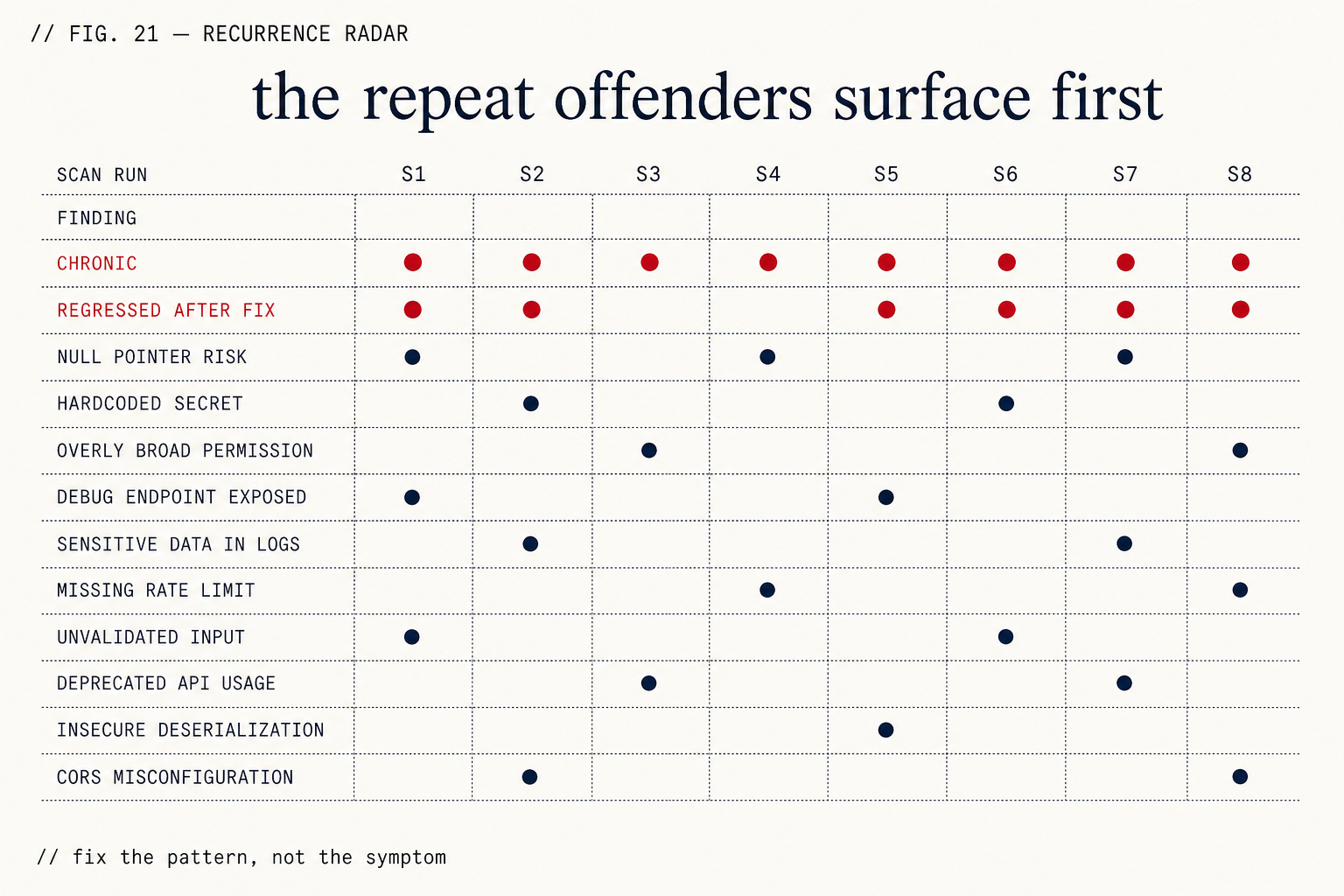
What you get
History per finding
The Brain tracks each finding across scans: how many runs it appeared in, whether it came back after a fix (regressed), or keeps recurring un-triaged (chronic).
Fix the pattern, not the symptom
Repeat offenders surface first, so you spend effort on the issues that actually keep breaking instead of re-reading a flat list every scan.
Regressions surface as regressions
When a finding you already fixed reappears in a later deploy, Recurrence Radar flags it as a regression rather than a brand-new issue — so a reintroduced RLS gap or a re-committed key reads as 'this came back', not one more line in a fresh report.
How recurrence intelligence works
- 1
ZipLoom records every finding on every scan.
- 2
It folds that history per issue across runs.
- 3
Each finding is tagged as new, recurring, regressed, or chronic.
- 4
Repeat offenders are surfaced ahead of one-off findings.
What this check inspects
Whether a finding matches one that was previously fixed on this project.
How many times a given issue has returned, and across which releases.
Which findings recur most often, which usually points at a pattern rather than an accident.
Whether a regression arrived with a specific release.
What it means when this fails
A fixed problem that comes back is a different signal from a new one: it usually means a prompt, a template, or a habit is reintroducing it. Treating it as new every time hides the pattern, and you fix the same thing forever.
Questions
- Why does a fixed issue reappear?
- Commonly because an AI tool regenerates a file from the same prompt that produced the original flaw. The fix was applied to the output, not the cause.
- What do I do with a recurrence?
- Fix the source — the prompt, the template, or the rule — rather than the symptom. That's the point of surfacing it as a recurrence.
- Does it track across branches?
- Findings are matched by fingerprint rather than by scan run, so they follow the issue rather than the branch.
What it replaces
Snyk Team
Per contributing developer, 5-seat minimum (~$1,500/yr entry). Code + dependency scanning; does not deploy your app.
GitHub Code Security
CodeQL scanning, Dependabot, dependency review. Billed per active committer; GitHub repos only.
ZipLoom Solo — all 28 features included
Deploy, security scan, and monitoring in one flat price. Guild $40/mo · Studio $70/mo · Business $299/mo.
Related features