security
Security Scan on Every Deploy
Catch RLS gaps, secret leaks, and CVEs before your app is reachable.
Real incident
The incident this prevents
Lovable CVE-2025-48757: 170+ applications built with the Lovable AI code generator were left with publicly readable databases. Root cause was a single unchecked Postgres setting — row-level security was never switched on. ZipLoom's RLS check would have caught this before the first deploy.
Source: Veracode · TechRadar · CVE-2025-48757
What you get
Row-level security enforcement
ZipLoom checks that RLS is enabled on every Postgres table before your app goes live. The Lovable CVE-2025-48757 incident (170+ publicly readable databases) and the Moltbook breach (1.5M authentication tokens) both traced to this single unchecked setting.
Secrets detection
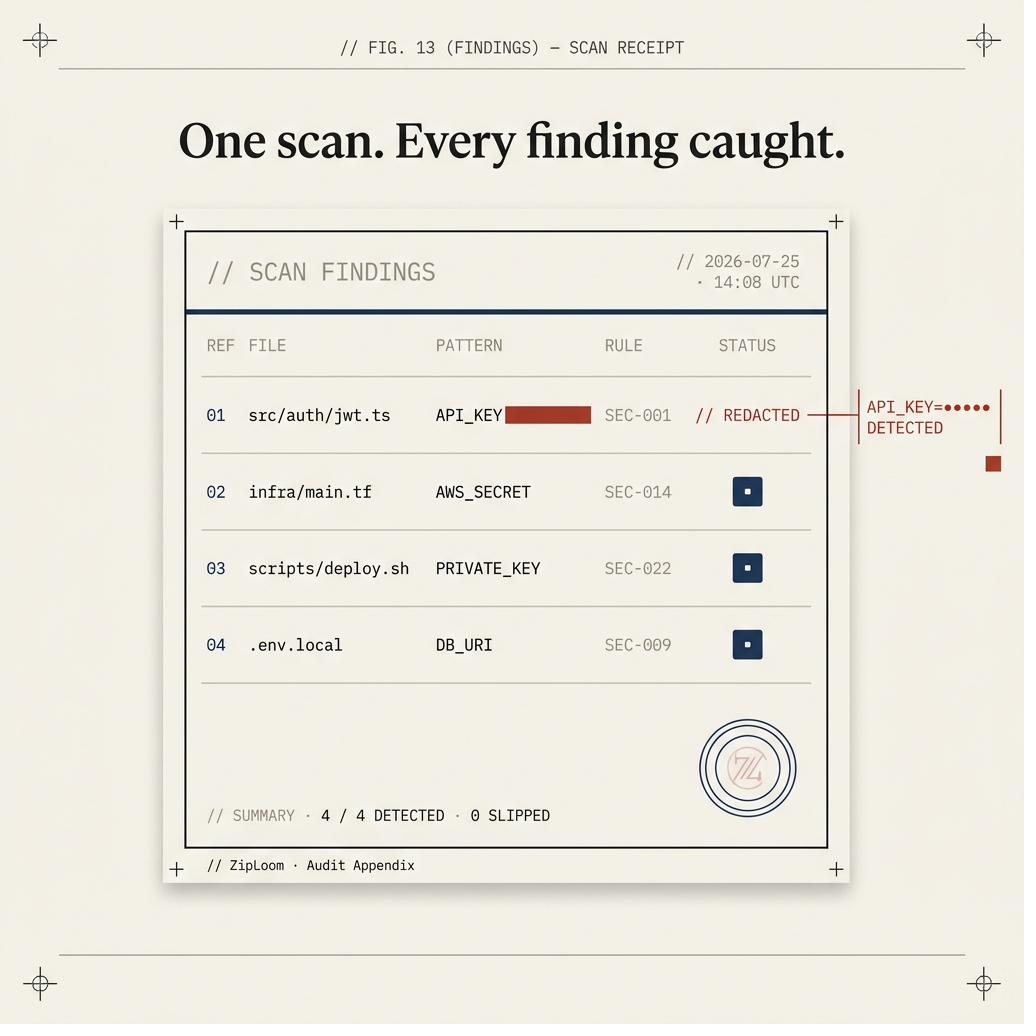
Scans for API keys, database URLs, and auth tokens in your codebase and environment config before deploy. Credentials in source code is the most common initial access vector in cloud breaches.
CVE and license audit
Checks your dependency graph against known CVEs. Also flags dependencies with GPL or AGPL licenses that could affect your commercial distribution rights — a real issue for SaaS products built on open-source stacks.
Zero configuration
No YAML files, no scan configuration, no custom rules to maintain. The scanner runs automatically on every deploy based on your detected framework and package manager.
How it works
- 1
You push your code or trigger a deploy from your dashboard.
- 2
ZipLoom's scanner reads your dependency manifest (package.json, requirements.txt, etc.).
- 3
Four checks run in parallel: RLS verification against your Postgres schema, secrets pattern matching across your codebase and env config, CVE lookup against the OSV database, and license classification of your dependency tree.
- 4
Results appear in your deploy dashboard before traffic is routed to the new version.
- 5
If you've set up the GitHub Actions integration, a failed scan blocks the merge — not just the deploy.
What this check inspects
Server-side code paths where user input reaches a database query, a file path, a shell command, or a template — the injection classes AI tools reproduce most often.
Authentication and authorization checks on every route that reads or writes user-owned data, including routes an AI added late and never wired to a guard.
Client bundles for credentials, internal URLs, and debug endpoints that were meant to stay server-side.
Framework configuration — the defaults that are safe in development and dangerous in production.
What it means when this fails
A critical finding means a stranger can reach something you intended to be private: a query they can alter, a record belonging to another account, or a key that unlocks a paid API. ZipLoom blocks the deploy rather than shipping it and telling you afterwards.
Questions
- Does this replace a penetration test?
- No. A pentest is a human expert probing your specific business logic. This catches the mechanical, repeatable mistakes AI tools make — which is most of what goes wrong, but not all of it. Treat it as the floor, not the ceiling.
- Will it block my deploy over something trivial?
- Only critical and high findings gate a deploy. Lower-severity findings are reported with the fix and let the release through, so the gate stays meaningful rather than something you learn to bypass.
- Does my code leave my repo?
- The scan runs against your repository and your deployed app inside ZipLoom's pipeline. Findings are stored with your organization; your source is not used to train anything.
What it replaces
Snyk Team
Per contributing developer, 5-seat minimum (~$1,500/yr entry). Code + dependency scanning; does not deploy your app.
GitHub Code Security
CodeQL scanning, Dependabot, dependency review. Billed per active committer; GitHub repos only.
Semgrep Team
SAST with a strong free OSS engine; rules and triage are yours to maintain.
ZipLoom Solo — all 28 features included
Deploy, security scan, and monitoring in one flat price. Guild $40/mo · Studio $70/mo · Business $299/mo.
Related features
Two-Factor Authentication
TOTP 2FA on every sign-in, before your code security even runs.
Learn moreAES-256-GCM Secrets Vault
Env vars encrypted at rest — decrypted only at deploy time, never in logs.
Learn moreGitHub Actions Integration
ziploom/scan-action gates every merge — security in the pipeline, not just at deploy.
Learn more