security
Vulnerable Dependency Audit
Every dependency against the National Vulnerability Database — critical and high, flagged.
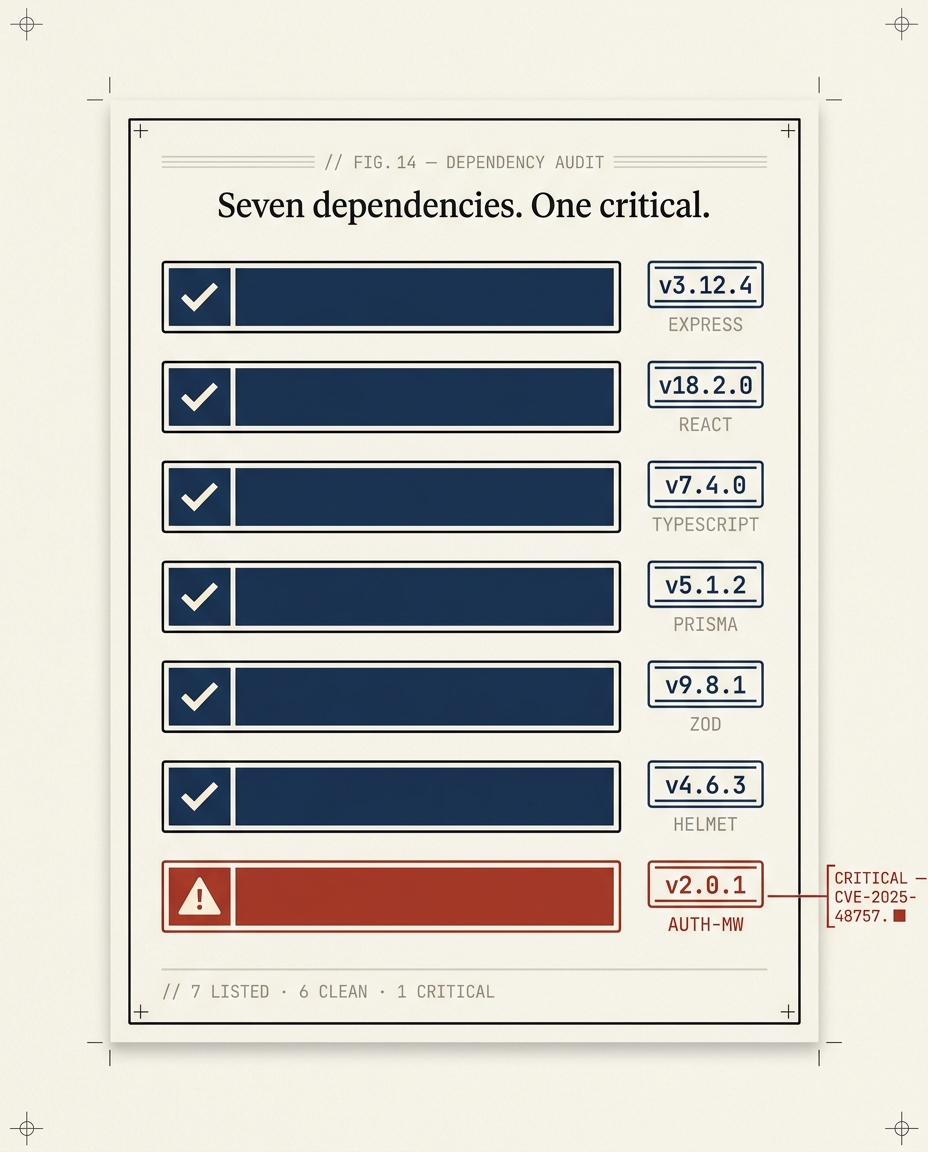
What you get
Checked against the NVD
Every declared dependency is checked against the National Vulnerability Database, so a known-vulnerable package is caught before it ships.
Critical and high, before build
Critical- and high-severity vulnerabilities are flagged before the build completes, not after users are exposed.
Transitive dependencies included
The audit walks the full dependency tree, not just the packages you named — most CVEs arrive through a dependency of a dependency. Each flagged package is reported with its CVE ID and severity so you can upgrade, pin, or accept it deliberately.
How the audit works
- 1
ZipLoom reads your dependency manifest.
- 2
Each dependency is checked against the National Vulnerability Database.
- 3
Critical and high findings are surfaced before the build ships.
What this check inspects
Every package in the dependency tree, not just the ones you named — most vulnerabilities arrive through a dependency of a dependency.
Each package version against the published CVE record, with the severity and the fixed version.
Whether a safe upgrade path exists, so you know if this is a version bump or a real migration.
Packages that are unmaintained or newly renamed — the supply-chain signals that precede a compromise.
What it means when this fails
A known CVE in a shipped dependency is a published, documented way into your app: the exploit is often public before you hear about it. Unlike a subtle logic bug, attackers can scan for it at scale, which is why unpatched dependencies are such a common breach route.
Questions
- Do I have to fix every finding?
- No. Fix what's reachable and severe. A critical CVE in code paths your app actually runs matters far more than a moderate one in a build-time-only tool — the report tells you which is which.
- Why did a new CVE appear when my code didn't change?
- Vulnerabilities are disclosed continuously. A package that was clean last month can be flagged today, which is why the audit runs on every deploy rather than once.
- What if there's no fix available?
- The report says so, so you can decide deliberately — pin it, replace the package, or accept the risk and record why. Finding Memory keeps that decision attached to the finding.
What it replaces
Snyk Open Source
Dependency/CVE scanning, per contributing developer, 5-seat minimum.
GitHub Code Security
CodeQL scanning, Dependabot, dependency review. Billed per active committer; GitHub repos only.
Semgrep Team
SAST with a strong free OSS engine; rules and triage are yours to maintain.
ZipLoom Solo — all 28 features included
Deploy, security scan, and monitoring in one flat price. Guild $40/mo · Studio $70/mo · Business $299/mo.
Related features